
An internal application can require a formal resume, a statement of interest, an internal form or a combination of documents. Start with the actual vacancy and process rather than assuming your employee record replaces the application. A hiring panel can include people outside your team, so make the relevant work understandable without relying on personal familiarity.
Constructed examples, not recorded candidates
The people, employers, qualifications, vacancy and work records in the examples below are fictional. The lateral-transfer sample is one complete resume. The promotion package is a separate set of excerpts, not a second complete resume. Neither is a successful-candidate testimonial, hiring prediction or recorded AI-generation result.
Check the internal process before preparing documents
Read the current internal-mobility policy and vacancy instructions. When something is unclear, ask the designated HR or recruiting contact how it applies to this role. Save a permitted copy or reference to the policy and posting so you know which requirements you used. A posting alone does not reveal the panel's preference, the number of eligible applicants or your probability of selection.
| Check | Question to resolve | Record before applying |
|---|---|---|
| Eligibility | Are there service, performance, location or qualification conditions, and who decides exceptions? | Current policy location/date, the relevant condition and any confirmed clarification; do not infer approval from a colleague's experience. |
| Application route and documents | Which portal, resume version, statement, references or internal form does this vacancy require? | Requisition, deadline, submission route and required attachments. |
| Manager notification | Must I notify my manager, at what stage, and will HR or a panel contact them? | The policy's timing and the contact who confirmed any uncertainty; distinguish notification from permission. |
| Confidentiality | Who can see the application and what performance or personnel information may be shared? | A realistic information-sharing expectation; do not assume the application is private. |
| Selection and development | Which qualifications must already be met, what will be assessed, and what training is available? | Essential versus preferred requirements and your actual evidence or gaps. |
| References and transition | Which references are requested, and when would a handover or release date be discussed? | Approved contacts and process steps; do not promise a transfer date or coverage you cannot authorize. |
As a named employer example, Duke's transfer and promotion policy directs staff to update their resumes and sets eligibility conditions. It describes current-supervisor notification before accepting a position and before the final reference check, plus sharing of specified performance information. Those are Duke's published procedures, not universal notification, reference or privacy rules. Check your own employer's requirements instead of copying Duke's timeline.
You can ask: What documents should I submit for this requisition? At what point is my current supervisor contacted, and by whom? Which qualifications must be demonstrated at application? Ask through the employer's designated channel; a response may clarify the process without confirming how the selection will turn out.
A lateral-transfer case: support specialist to training coordinator
Constructed vacancy: Cedarbridge Services advertises Training Coordinator (TC-214). The role coordinates learning sessions, prepares job aids with subject-matter reviewers, maintains attendance records and communicates scheduling changes. Relevant coordination and written-communication evidence is required. Learning management system (LMS) administration is preferred. This fictional posting does not require prior line-management experience; real postings may have different conditions.
| Fact | Underlying record | Boundary |
|---|---|---|
| Support Specialist at Cedarbridge Services, Columbus, OH; July 2023–Present | Employment record establishes the official title, location and dates. | The candidate has not held the Training Coordinator title. |
| Six support job aids updated in Word, January–August 2026 | A revision log identifies six distinct documents and the training lead's final review. | Updating documents is not ownership or approval of the curriculum. |
| Four new colleagues received one orientation walkthrough each, January–August 2026 | Outlook invitations and the approved orientation checklist identify four sessions and four participants. | Peer orientation did not include direct reports, hiring decisions or performance assessment. |
| Eight weekly attendance summaries in Excel, February–March 2026 | Eight weekly files and their review messages identify the output and period. | The candidate did not run an LMS or measure improved learning outcomes. |
| Earlier Service Desk Assistant, September 2021–June 2023 | Employment record plus booking schedules and handover responsibilities. | The earlier role was customer-facing coordination, not a professional training appointment. |
| Associate of Arts, General Studies, May 2021; no professional training credential claimed | Constructed education record for the fictional Westmere Community College. | No LMS administration experience, course-design qualification or people-management experience is asserted. |
| Posting requirement | Available evidence | Truthful wording / placement | Limit or gap |
|---|---|---|---|
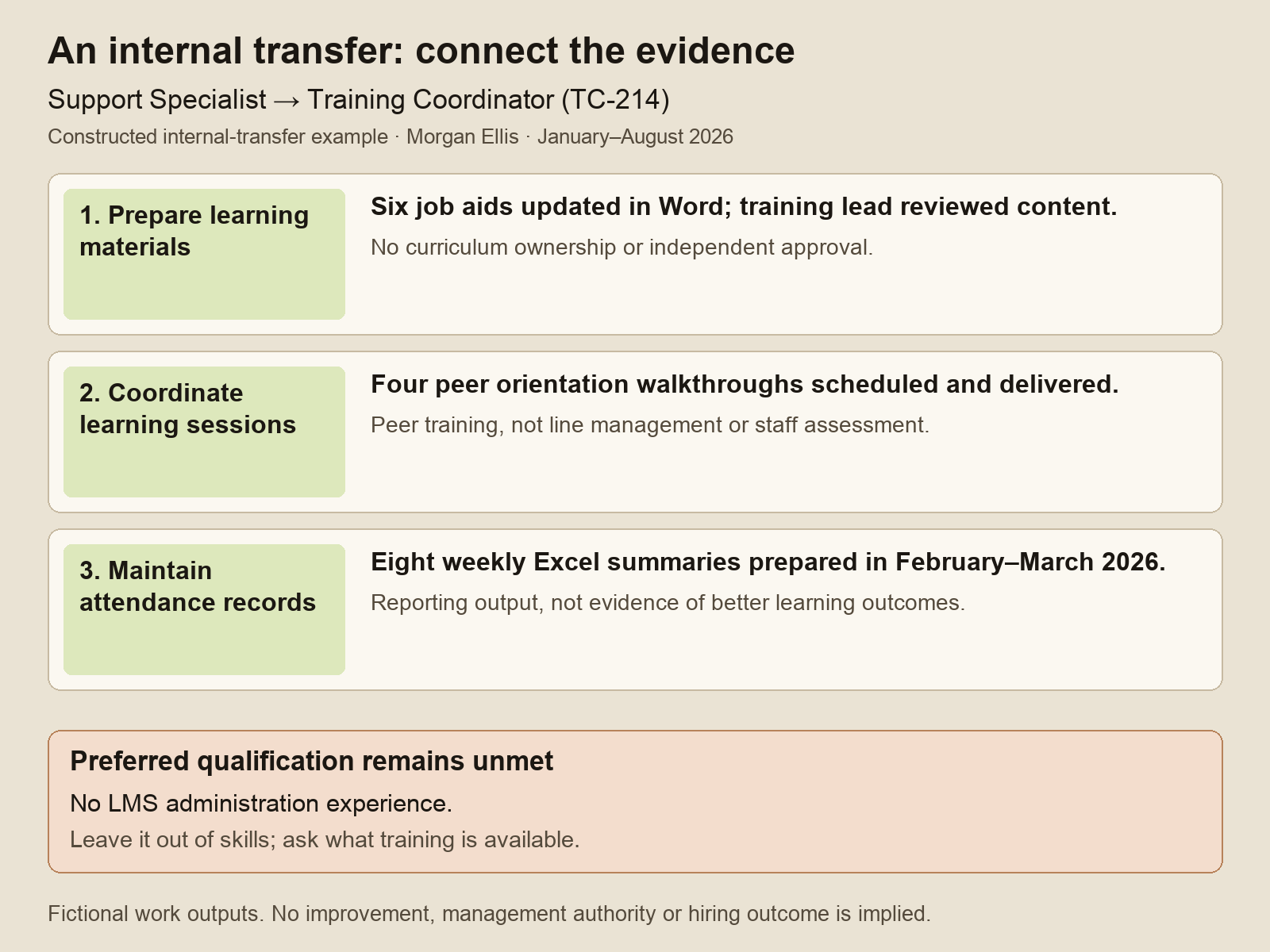
| Prepare learning materials | Six job aids updated in Word; training lead reviewed content. | Updated six support job aids in Word for training-lead review. | No curriculum ownership or independent approval. |
| Coordinate learning sessions | Four peer orientation walkthroughs scheduled and delivered. | Scheduled and delivered orientation walkthroughs for four new colleagues. | Peer training, not line management or staff assessment. |
| Maintain attendance records | Eight weekly Excel summaries prepared in February–March 2026. | Prepared eight weekly attendance summaries in Excel for lead review. | Reporting output, not evidence of better learning outcomes. |
| Communicate scheduling changes | The candidate sent Outlook invitations and coordinated updates with the training lead. | Name Outlook session scheduling in skills and explain the walkthroughs in experience. | Scheduling sessions is not authority over staffing or training strategy. |
| Preferred: learning management system administration | No LMS administration experience. | Leave it out of skills; ask what training is available. | If LMS administration is mandatory for the real role, this application may not meet that requirement. A willingness to learn is not existing proficiency. |
The evidence supports a move toward training coordination without rewriting the current job. UConn's section guidance explains how employment, projects and other experience can supply relevant evidence. Select the sections that fit the candidate and the request. Keep detailed chronology in the work-experience guide, and use the tailoring method for a fuller requirement-to-evidence editing exercise.
Complete illustrative resume for the internal transfer
Professional Summary
Support Specialist applying for Training Coordinator (TC-214) at Cedarbridge Services. Experience updating support job aids, delivering peer orientation walkthroughs and preparing attendance summaries for training-lead review. Brings knowledge of the support workflow; has not administered a learning management system.
Core Skills
Experience
- Updated six support job aids in Word for training-lead review. January–August 2026; the lead approved final content.
- Scheduled and delivered orientation walkthroughs for four new colleagues. January–August 2026, using Outlook invitations and the lead's approved checklist.
- Prepared eight weekly attendance summaries in Excel for lead review. February–March 2026; the lead resolved missing attendance details.
- Document customer inquiries and route unresolved account questions to the authorized support team; do not approve account adjustments.
- Recorded activity bookings and prepared room schedules for coordinator review.
- Maintained a shift handover log of visitor inquiries and referred unresolved requests to the duty coordinator.
Education
Associate of Arts, General Studies — Westmere Community College | May 2021. Institution and qualification are fictional details for this constructed sample.
| Decision | Why it helps | What it does not establish |
|---|---|---|
| Name the target requisition in the summary | The document makes the requested move explicit while retaining Support Specialist as the current official title. | The candidate has not already been appointed or promoted. |
| Connect document editing to six identifiable job aids | The count describes distinct outputs within January–August 2026, supported by a revision log. | There is no claim of reduced training time, fewer errors or independent curriculum ownership. |
| Describe four peer orientation walkthroughs | The number matches the four sessions and four colleagues in the fact sheet. | Peer training does not establish supervision, performance management or formal instruction credentials. |
| Specify eight weekly Excel attendance summaries | The record supports the output and February–March 2026 period. | There is no invented attendance-rate improvement or LMS experience. |
| Keep earlier desk work concise | Booking records and handovers support coordination evidence without overwhelming the current role. | The older title and dates have not been converted into extra training experience. |
| Keep the preferred LMS gap visible | The summary and matrix agree; the tool does not appear as a skill. | The resume does not claim that an unresolved qualification will be overlooked. |
Misleading → accurate: Managed onboarding and led four employees becomes Scheduled and delivered orientation walkthroughs for four new colleagues using the lead's approved checklist. The useful contribution remains; direct-report authority disappears because it was never part of the facts. Describe a number only when its unit and period are clear. See how to check achievement numbers when the record is less straightforward.
Translate internal language without disclosing restricted information
| Internal wording | Clearer application wording | Check before sharing |
|---|---|---|
| Owned the Blue Desk pack | Updated six support job aids in Word for training-lead review. | Use a safe functional description instead of a restricted internal project name; retain approval limits. |
| Ran buddying | Scheduled and delivered orientation walkthroughs for four new colleagues. | Explain the activity rather than implying line management. |
| Did the Friday sheet | Prepared weekly attendance summaries in Excel for the training lead. | Name the output and task; do not attach individual attendance records. |
| Handled TC exceptions | Recorded incomplete attendance details and referred them to the training lead. | Expand an acronym only if its meaning is accurate and permitted; do not expose learner or customer details. |
An internal audience is not automatically authorized to see every customer name, personnel record, financial figure or unreleased plan. Use aggregate or functional descriptions when permitted, and obtain approval before including an artifact. Do not keep restricted source files in a personal portfolio to make a resume claim easier to demonstrate. If a number cannot be safely used, a specific qualitative description can still explain the work.
A shorter package for an internal promotion
Separate constructed fact sheet: Taylor Kim has been an Operations Coordinator at fictional Pine Orchard Services since March 2024. From April through September 2026, Taylor prepared six monthly exception summaries, documented one supervisor-approved handover checklist and coordinated the rota for three volunteers at two staff events. Taylor has no direct reports and did not approve staffing or payments. The advertised Senior Operations Coordinator role adds responsibility for reviewing incomplete records, maintaining handover documentation and coordinating event tasks; personnel supervision is not part of this fictional posting.
Illustrative promotion summary excerpt
Operations Coordinator applying for Senior Operations Coordinator. Prepares monthly exception summaries and maintains a supervisor-approved handover checklist; experience coordinating volunteer assignments for staff events. Seeking the advertised record-review and documentation responsibilities, with final staffing and payment decisions retained by authorized managers.
- ▸Prepared six monthly exception summaries from April–September 2026, flagging incomplete entries for supervisor review.
- ▸Documented a handover checklist approved by the operations supervisor; maintained the agreed version as contact procedures changed.
- ▸Coordinated rota assignments for three volunteers across two staff events and escalated schedule conflicts to the supervisor.
Illustrative statement of interest
I am applying for Senior Operations Coordinator because the record-review and handover responsibilities fit work I have already supported. The six monthly summaries and approved checklist are examples I can discuss without sharing restricted records. I would like to understand the senior role's review authority and development expectations. If selected, I would work with the relevant managers on a handover; I cannot commit to a transfer date or staffing arrangement independently.
Annotation: this is a summary, three selected bullets and a statement of interest, not a complete promotion resume. The facts show preparation, documentation and coordination. They do not support Managed the operations team, Approved payments or Already performing every senior responsibility. The official current title stays Operations Coordinator until a promotion actually takes effect. For a promotion already held, use the separate title/date structure rather than backdating the new title.
Submission checklist for an internal application
- ▸Confirm the vacancy, deadline, eligibility and required submission route against current instructions.
- ▸Resolve manager-notification, reference and information-sharing questions before relying on confidentiality.
- ▸State the target role while retaining current official titles, employer relationships and accurate dates.
- ▸Connect required and preferred qualifications to specific evidence; leave an unmet tool or qualification visible.
- ▸Expand internal shorthand and distinguish personal work, team outcomes, reviewer authority and final approvals.
- ▸Check that every number has an identifiable record, unit and period; omit unsupported improvements.
- ▸Remove restricted information and attachments you are not permitted to share with this audience.
- ▸Review uploaded documents and application fields separately, including dates and any autofilled title.
- ▸Keep a permitted copy of the submitted version and posting, plus a record of process clarifications.
- ▸Discuss handover options when requested without promising staffing decisions or a start date you cannot authorize.
Internal applications still need readable files and accurate form answers. Use the formatting submission checklist and follow the employer's requested file format. A successful upload or a high Resume Leap score does not establish that the application meets eligibility rules, that the panel will select it or that restricted information can be shared.
Review the outcome without turning statistics into a forecast
If selected, confirm the role, effective date, responsibilities, reporting relationship, compensation and agreed transition in the appropriate written documents. Ask which training or support addresses remaining gaps. Use the offer-review guide for evaluating actual terms; do not derive a personal raise target by combining unrelated promotion averages and external-hire studies.
If not selected, ask for feedback on specific requirements and evidence: Which responsibility needed stronger proof? Was the preferred LMS experience material? What could I demonstrate before another application? Feedback availability and development support vary. A rejection, silence or a general internal-hiring statistic cannot establish the hidden reason for one decision or predict whether you will leave the employer.
This guide concerns applying while currently employed by the organization. For a return after leaving, see returning to a former employer. For a change of profession, use the career-change guide. Keep the same factual base across applications even when the evidence selected for each role differs.