
Data Analyst Resume Examples and Writing Guide
What makes a strong data analyst résumé
A data analyst resume should connect relevant tools and methods to work you can explain: the question, data, checks, analysis and your contribution. The constructed samples below show an experienced analyst and a project-based applicant. Use supported scope or measured results when available, distinguish project outputs from business impact, and compare your evidence with the particular posting’s requirements.
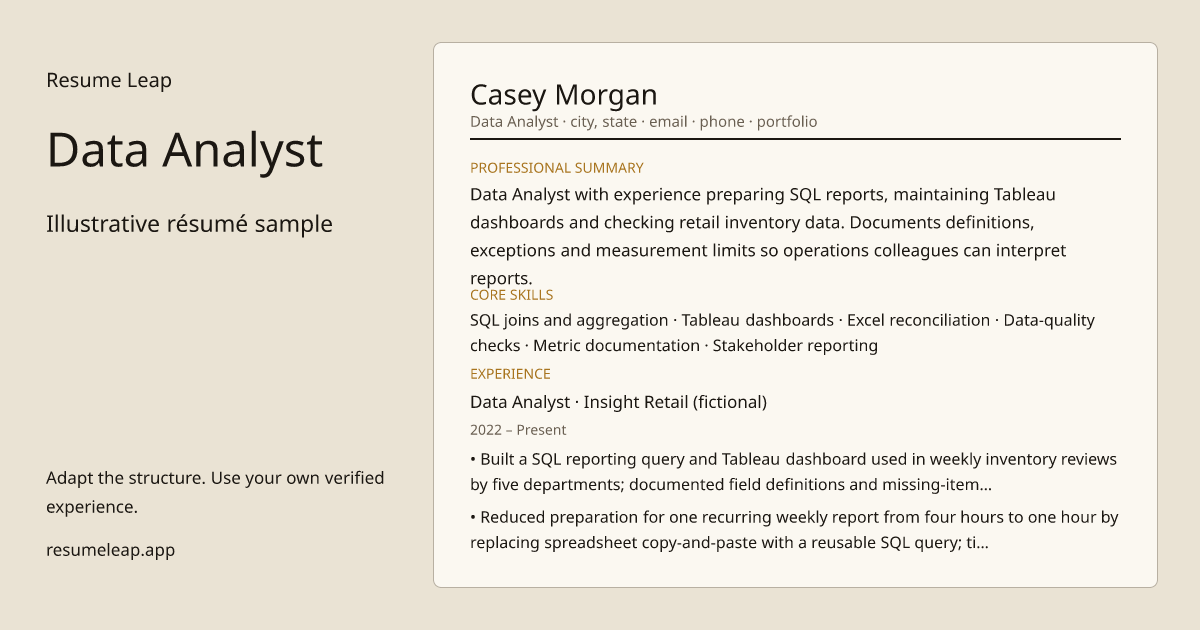
Data Analyst résumé sample
This is an illustrative résumé. Names, organizations and accomplishments are constructed examples; replace them with your own verified experience.
Professional Summary
Data Analyst with experience preparing SQL reports, maintaining Tableau dashboards and checking retail inventory data. Documents definitions, exceptions and measurement limits so operations colleagues can interpret reports.
Core Skills
Experience
- Built a SQL reporting query and Tableau dashboard used in weekly inventory reviews by five departments; documented field definitions and missing-item exceptions.
- Reduced preparation for one recurring weekly report from four hours to one hour by replacing spreadsheet copy-and-paste with a reusable SQL query; timed four comparable runs before and after.
- Compared eight weeks of stock and sales records, identified incomplete supplier identifiers and documented the limits of the comparison before presenting it to operations colleagues.
- Prepared weekly campaign reports in Excel and SQL, separating delivery, click and order measures and flagging changes in source definitions.
- Reviewed a 120,000-row reporting extract for duplicate identifiers and missing fields; recorded 12 exceptions for the data owner to investigate.
- Maintained a shared reporting glossary and explained report filters during monthly team reviews; campaign decisions remained with the marketing team.
Education
B.S. in Statistics · Example University (fictional) · 2020
Project-based entry-level data analyst sample
Constructed applicant with relevant coursework and one reproducible practice project, but no professional data analyst role. All names and background details are fictional.
This alternative is also a constructed example. Replace its organizations, experience and numbers with your own supported facts.
Education
B.S. in Information Systems · Example University (fictional) · May 2026 Relevant coursework: databases and introductory data analysis
Core Skills
Projects
Independent reproduction of a Resume Leap instructional exercise; all records are fictional.
- Reproduced ticket-volume counts in SQLite for 48 fictional support tickets: 46 resolved and 2 unresolved; grouped counts by channel.
- Calculated a mean of 16.97 elapsed calendar hours across the 46 resolved records, excluding 2 unresolved tickets from the time average.
- Documented the timestamp calculation, unresolved-record exclusion and interpretation limits alongside the readable SQL and reproduction instructions.
Experience
- Checked returned items against circulation records and escalated discrepancies to the library supervisor.
- Answered borrowing-policy questions and recorded unresolved requests for the next shift using the shared desk log.
Why this example is written this way
- Education and the project lead because this applicant has no professional analyst experience. An introductory summary is optional and omitted here.
- The library role remains Library Desk Assistant; handling records does not make it a data analyst position.
- The project demonstrates basic SQLite queries and documentation. The supplied data, SQL and chart are instructional materials, not a real customer study or original operational improvement.
- Python is limited to the CSV import used by the reproduction instructions. Do not infer pandas, production pipelines or advanced modeling experience.
- The portfolio link is a header placeholder. Replace it with a working, permitted project link and explain which parts you completed yourself.
The experienced sample: source facts and annotations
Both resumes on this page are constructed teaching examples, not real applicants or hiring results. The experienced sample’s fictional source facts below explain what supports each claim. Use your own records and contribution when adapting it; do not copy the invented employers or figures.
| Sample fact | Evidence assumed in this example | Interpretation limit |
|---|---|---|
| Weekly report used by five departments | Dashboard access list and the recurring inventory-review agenda | Adoption is scope; it does not establish improved revenue or inventory accuracy. |
| Preparation changed from four hours to one hour | Four comparable timed runs before and after the query change | A measured three-hour difference for this report; not an annual savings projection or elimination of human review. |
| Eight weeks of stock and sales records | Defined extract dates and a written list of missing supplier identifiers | An exploratory comparison, not proof that a pricing change would improve margin. |
| 120,000-row extract and 12 recorded exceptions | Row-count query and issue log from one reporting extract | Workload and checks performed; no claim that all source errors were found or corrected. |
Map the posting’s requirements to available evidence
The example below uses a hypothetical junior analyst posting. Treat required and preferred qualifications differently, keep gaps visible, and select truthful wording. O*NET’s Business Intelligence Analysts profile describes representative tasks; it does not prescribe one software stack for every data analyst job.
| Requirement | Evidence in the entry-level sample | Truthful wording or unresolved gap |
|---|---|---|
| Required: basic SQL aggregation | Reproduced GROUP BY counts and AVG calculations in SQLite | SQL aggregation in an instructional project; not professional database administration. |
| Required: explain data checks | Checked row counts, unresolved records and resolution-time exclusions | Documented validation and missing-value handling in the practice exercise. |
| Required: communicate findings | Wrote a reproduction README and a limitations note | Documented findings and their limits; no claim of presenting to business executives. |
| Preferred: Power BI | No Power BI work in the fact sheet | Unmet preference. Do not add Power BI to the skills list. |
| Required: one year of professional analyst experience | Coursework and a practice project only | Unmet requirement. A project does not become a year of employment. |
Inspect the project analysis artifact
The shared instructional dataset has 48 fictional tickets and 2 unresolved records. SQLite computes volumes for all tickets and average elapsed resolution hours only for the 46 resolved tickets. The overall resolved-ticket average is 16.97 hours. The calculation uses UTC opening and resolution timestamps; results are rounded to two decimals.
| Channel | Total tickets | Resolved tickets | Mean elapsed resolution hours |
|---|---|---|---|
| 16 | 15 | 17.33 | |
| chat | 16 | 16 | 16.81 |
| web | 16 | 15 | 16.77 |
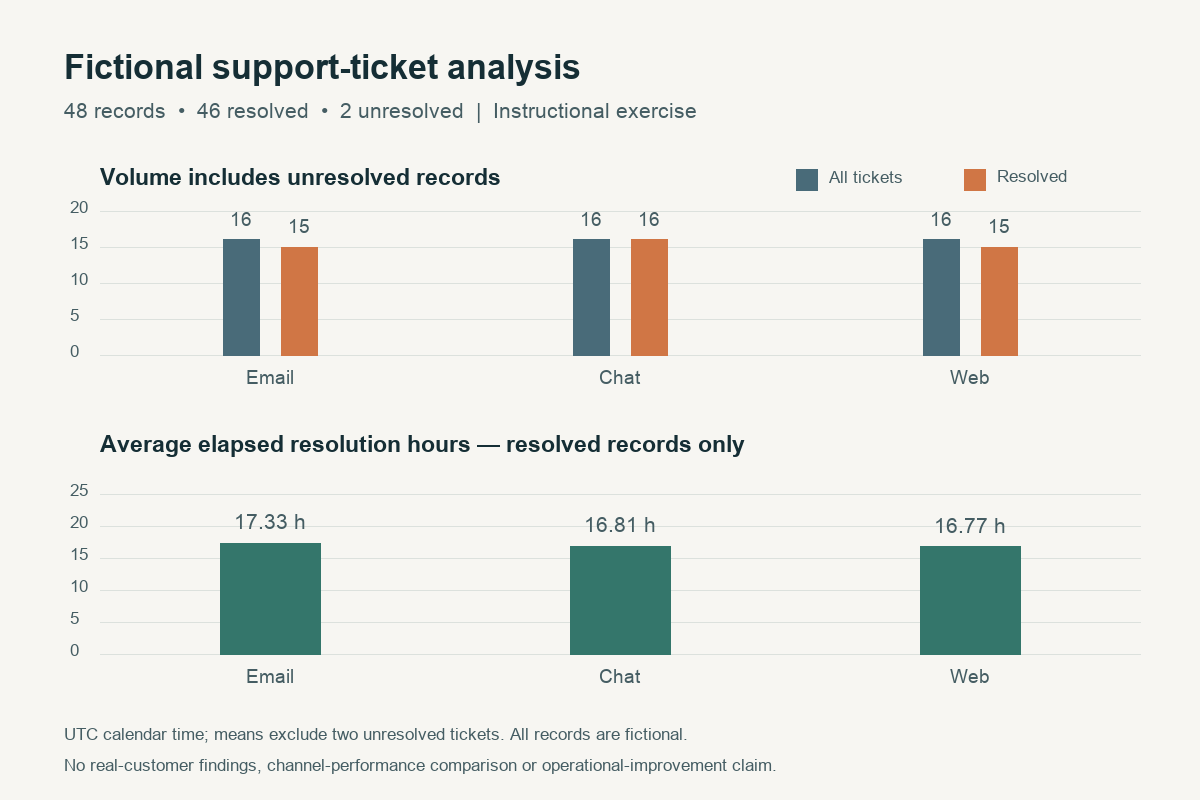
The editorial exercise ZIP contains the fictional CSV, readable SQL and Python-standard-library reproduction instructions. The projects-section guide explains how to describe this work and distinguish supplied materials from your own contribution. The chart is an editorial illustration of the shared calculation, not a screenshot proving this fictional applicant completed it.
What these results do not establish
These are elapsed calendar hours between opening and resolution, not active handling time or a service target. Excluding unresolved tickets changes the denominator. The small, deliberately constructed dataset cannot establish a better channel, a before/after improvement, real customer behavior or commercial impact.
Choose supported skills and make the portfolio inspectable
Use the skills-section examples to group tools and methods you can demonstrate. A portfolio should state the question, source, your contribution, reproducible steps and limitations; remove confidential records and check the link without signing in. If a short introduction helps orient the reader, use the summary examples. Do not force a summary or a business-impact number into a project that does not support one.
Job-description terms for a data analyst résumé
These role-related terms are prompts for reviewing a specific job description. Include only terms that accurately describe your experience. Employers use different systems and criteria; this list does not represent a universal scoring model.
Common data analyst résumé mistakes
- ✕Listing SQL, Python or a BI tool without explaining the work you completed with it.
- ✕Claiming a business improvement from a classroom or synthetic-data exercise; describe the analysis output and its limitations instead.
- ✕Reporting a percentage without the baseline, denominator, period or evidence for your contribution.
- ✕Presenting a supplied dataset or team deliverable as wholly your own work; distinguish preparation, analysis and review roles.
- ✕Sharing confidential records in a portfolio or using a broken link without a readable explanation of the project.
Frequently asked questions
What skills should a data analyst put on a resume?
How do I write a data analyst resume with no experience?
Should a data analyst resume include a portfolio link?
How should I describe numbers from an analysis project?
Build a résumé from your own experience
Create an account, add your own profile and a target job description, then use Resume Leap to draft and review your résumé. This signup link does not import the sample. Export a PDF and follow the employer’s requested format.
Keep exploring
Resume example
Data Scientist Resume Example
Resume example
Business Analyst Resume Example
Resume example
Financial Analyst Resume Example
Guide
Resume Projects Section Examples: How to Show Your Work
Guide
Resume Skills Section Examples: What to Include and How to Organize It
Guide