
A clear education section distinguishes what you earned from what you studied. That distinction matters more than choosing a fashionable heading or adding a long course list. Start with the institution's record, select details relevant to the application and keep the qualification's actual status visible.
Six constructed partial entries
All candidates, institutions, providers and education records in these six cases are fictional. The entries demonstrate wording and status only; they are not complete resumes, successful-candidate testimonials or qualifications you should claim. Replace the sample details with your own supported record.
Choose an education entry that matches your record
CareerOneStop's education guidance distinguishes earned credentials, current study and attended-but-uncompleted programs. Use those distinctions without treating its suggested GPA or date thresholds as universal rules. UConn's section guidance also emphasizes organizing the document around relevant evidence. A posting or application may request information that an otherwise concise resume omits.
| Actual status | Useful wording | Avoid implying |
|---|---|---|
| Credential awarded | The actual credential and field; include accurate completion information when useful or requested. | A different degree, major, honors distinction or professional authority. |
| Currently enrolled | Program name and current enrollment; label a supported future completion date as expected. | That a planned degree has already been awarded. |
| Not enrolled; no degree awarded | Coursework or study toward the program, with accurate attendance or completed-credit context where useful. | That the last attendance year was graduation or that there is a current completion plan. |
| Transfer between institutions | Separate schools and their actual status when both are relevant. | Attendance at one school throughout a period spent at two. |
| Course completed | Provider, course and completion status; use the name on the actual document. | An independent professional certification, degree or license. |
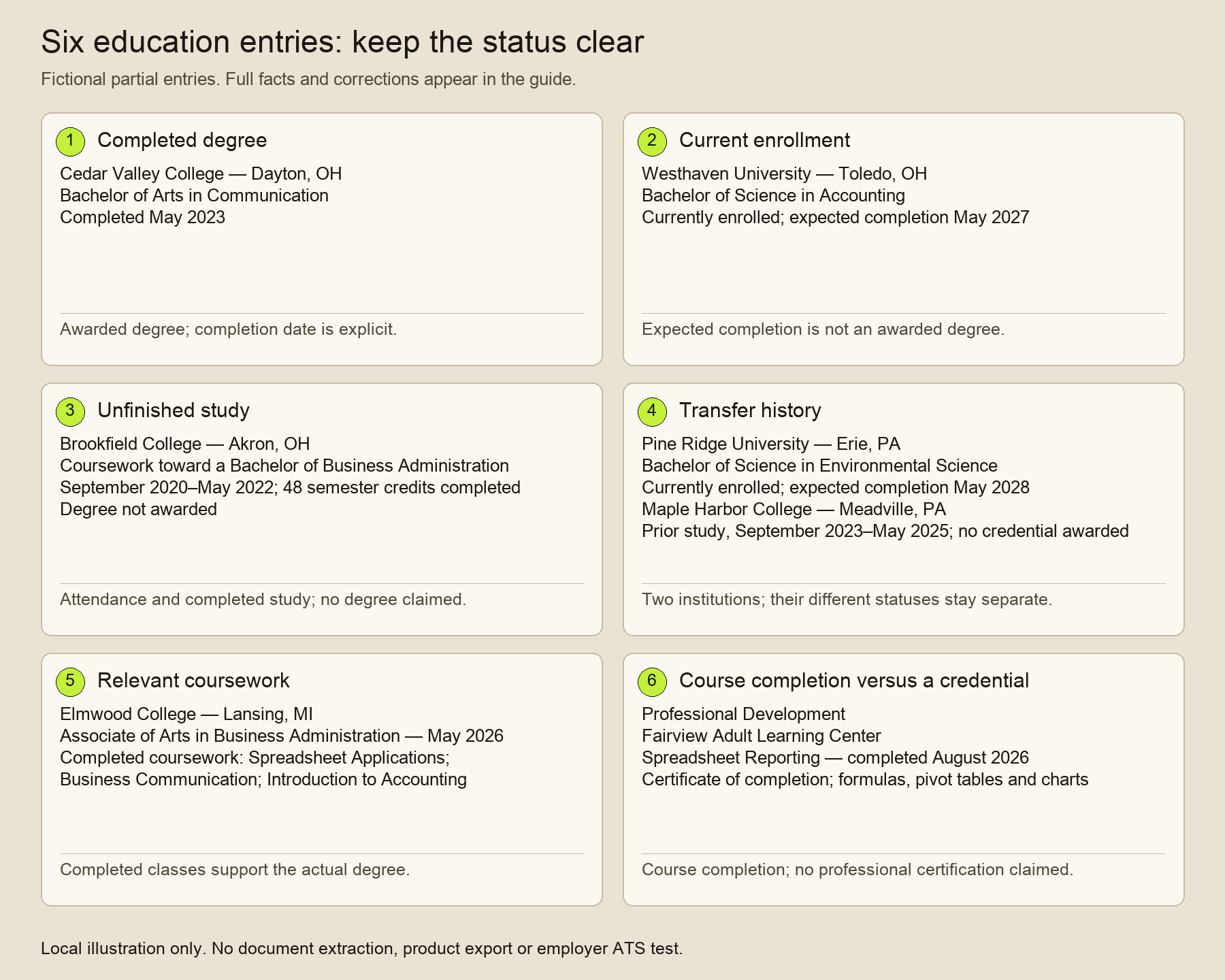
Case 1: Completed degree
Constructed fact sheet: The fictional candidate received a Bachelor of Arts in Communication from Cedar Valley College in May 2023. The award appears in the candidate's academic record. No minor, honors distinction or professional credential is claimed.
| Entry line |
|---|
| Cedar Valley College — Dayton, OH |
| Bachelor of Arts in Communication |
| Completed May 2023 |
Why this wording fits: The entry names the awarded degree and separates the completion date from a period of attendance. The full field name is useful when an abbreviation could be unclear. Honors or a minor would need their own supporting record before being added.
| Misleading wording | Accurate correction |
|---|---|
| Bachelor of Arts in Communication with honors, 2020–2023 | Bachelor of Arts in Communication — completed May 2023. Remove the unsupported honors claim; the graduation date identifies completion without implying a separate credential. |
Case 2: Current enrollment
Constructed fact sheet: The fictional candidate is currently enrolled in Westhaven University's Bachelor of Science in Accounting program. Their current study plan anticipates May 2027 completion, but the university has not awarded the degree. The candidate will review that estimate if the plan changes.
| Entry line |
|---|
| Westhaven University — Toledo, OH |
| Bachelor of Science in Accounting |
| Currently enrolled; expected completion May 2027 |
Why this wording fits: The expected label keeps the future qualification distinct from an earned degree. The date reflects the candidate's current plan, not a guarantee. On a form asking for the highest completed qualification, this program must not be entered as a completed bachelor's degree.
| Misleading wording | Accurate correction |
|---|---|
| Bachelor of Science in Accounting, 2027 | Bachelor of Science in Accounting — currently enrolled; expected completion May 2027. Make both the enrollment status and the future date clear. |
Case 3: Unfinished study
Constructed fact sheet: The fictional candidate attended Brookfield College from September 2020 through May 2022 and completed 48 semester credits toward a Bachelor of Business Administration. They are not currently enrolled, have not earned the degree and have no established return or completion date.
| Entry line |
|---|
| Brookfield College — Akron, OH |
| Coursework toward a Bachelor of Business Administration |
| September 2020–May 2022; 48 semester credits completed |
| Degree not awarded |
Why this wording fits: The entry describes completed study and attendance dates without turning the last attendance year into a graduation date. The credit count is included because this fictional transcript establishes it. It does not claim that all credits would count toward a future program. No reason for leaving or personal explanation is necessary in this sample.
| Misleading wording | Accurate correction |
|---|---|
| Bachelor of Business Administration, 2022 | Coursework toward a Bachelor of Business Administration — 48 semester credits completed, September 2020–May 2022; degree not awarded. Do not invent an expected graduation date for a program you are not pursuing. |
Case 4: Transfer history
Constructed fact sheet: The fictional candidate attended Maple Harbor College from September 2023 through May 2025 without earning a credential, then transferred to Pine Ridge University in September 2025. They are currently enrolled in Pine Ridge's Bachelor of Science in Environmental Science program with expected completion in May 2028. The sample makes no GPA or transferred-credit claim.
| Entry line |
|---|
| Pine Ridge University — Erie, PA |
| Bachelor of Science in Environmental Science |
| Currently enrolled; expected completion May 2028 |
| Maple Harbor College — Meadville, PA |
| Prior study, September 2023–May 2025; no credential awarded |
Why this wording fits: The institutions and statuses remain separate. The candidate does not appear to be a current degree candidate at the former school or to have earned two qualifications. Keeping both schools helps explain this particular timeline; it is not a rule that every transfer applicant must always include every institution on the resume. A form requesting all institutions attended still needs its requested history.
| Misleading wording | Accurate correction |
|---|---|
| Pine Ridge University — Bachelor of Science, September 2023–May 2028 | Give Pine Ridge the current program and expected completion, then identify Maple Harbor as prior study. Do not move the university's start date back to include attendance at a different institution. |
Case 5: Relevant coursework
Constructed fact sheet: The fictional candidate earned an Associate of Arts in Business Administration from Elmwood College in May 2026. Their academic record confirms completed courses titled Spreadsheet Applications, Business Communication and Introduction to Accounting. The sample does not claim accounting employment or a professional accounting credential.
| Entry line |
|---|
| Elmwood College — Lansing, MI |
| Associate of Arts in Business Administration — May 2026 |
| Completed coursework: Spreadsheet Applications; |
| Business Communication; Introduction to Accounting |
Why this wording fits: A short coursework line identifies relevant study without relabeling the degree or presenting classroom learning as professional experience. Include courses that help explain a qualification for the application rather than copying a transcript. If a course is still being taken, label it as in progress instead of including it among completed courses. Show substantial project evidence in a separate, accurately labeled project entry.
| Misleading wording | Accurate correction |
|---|---|
| Associate degree in Accounting; professional accountant | Keep the actual Business Administration degree and identify Introduction to Accounting as completed coursework. A course does not change the awarded major or establish professional employment. |
Case 6: Course completion versus a credential
Constructed fact sheet: The fictional candidate completed a Spreadsheet Reporting course at Fairview Adult Learning Center in August 2026 and received a certificate of completion. The course covered formulas, pivot tables and charts. The provider is fictional; this example describes no actual certification program, professional license or externally assessed credential.
| Entry line |
|---|
| Professional Development |
| Fairview Adult Learning Center |
| Spreadsheet Reporting — completed August 2026 |
| Certificate of completion; formulas, pivot tables and charts |
Why this wording fits: The wording identifies the provider, actual learning activity and completion document. A certificate of completion is not automatically a professional certification. Use an issuer's exact credential name and status only if you actually earned it and satisfy any current requirements. Training for an examination belongs under preparation or study, not under earned certifications.
| Misleading wording | Accurate correction |
|---|---|
| Certified Spreadsheet Reporting Professional | Spreadsheet Reporting course — certificate of completion, August 2026. Do not invent a professional credential from the name of a course or its completion document. |
Build an evidence worksheet before editing
| Record | What to establish | Writing decision |
|---|---|---|
| Institution or provider | Official name, campus or location where it prevents ambiguity, and the relevant academic record. | Use an identifiable name; do not substitute a more familiar institution. |
| Credential or program | Exact degree, field, minor or course name and whether it was awarded, completed or only pursued. | Keep status explicit; do not rename a major to match a job description. |
| Dates | Award date, actual attendance period, or a current supported expected completion date. | Keep completion separate from attendance and do not guess an uncertain date. |
| Completed credits or courses | Transcript-backed units and course titles; identify whether units are semester credits or another measure. | Include only relevant and supported details; do not imply all prior credits transfer. |
| GPA or honors | Institution, scope, scale and exact recorded result; distinguish cumulative and major GPA. | Label optional figures accurately rather than rounding into an unearned distinction. |
| Credential status | Issuer, exact earned credential, relevant validity or expiry information and completion requirements. | Separate course completion and exam preparation from earned certification or licensure. |
Keep private academic records securely and provide them only through the requested process. An academic record can support a qualification claim without belonging in a public portfolio. If the work itself matters more than the course title, use the projects-section examples for an accurately labeled project. If a job requires a professional license, confirm the current issuer or regulator requirements separately; a degree entry does not establish authorization to practice.
GPA, transfer records and relevant coursework
Follow a request for GPA or transcripts accurately. Otherwise, decide whether GPA adds useful evidence for this application rather than applying a universal cutoff. If included, identify what it measures and its scale. Do not label a major GPA as cumulative, casually average GPAs from different schools or supply a conversion you cannot support.
Penn's transfer-student FAQ treats institutional GPAs separately and warns that a combined figure must be accurate and clearly identified. Its student-specific advice is not a requirement for all applicants. In this guide's transfer case, neither GPA is included, so no cross-institution calculation is implied.
Use coursework to explain relevant learning when the degree title alone does not show it. Distinguish completed classes from those in progress and avoid a transcript-length list. Course names establish study, not workplace proficiency. A skills section can connect supported tools to what you actually did, and a no-experience resume can combine education with other truthful evidence.
Where to place education and which dates to show
Place education where its relevance helps the reader assess the application. Current study, a recent qualification or a required credential may deserve early visibility. Relevant work may justify placing experience first. Neither a fixed number of years since graduation nor a universal age rule decides the order.
Use accurate graduation or expected-completion information when requested or when it clarifies status. An optional graduation date may be omitted from a resume when the entry remains clear, but that is a presentation choice, not a tested guarantee against age discrimination. Do not alter the date or withhold a date from a form that asks for it. The age-discrimination guide separates research findings from optional presentation choices.
Include high school when it is relevant to the qualification you need to establish or requested by the employer; its usefulness changes with the rest of your record. Do not invent a college credential to replace it. Use the length guide to decide which details deserve space rather than forcing every education entry into a fixed number of lines.
Resume choices and application-form answers are different
| Question | Resume choice | Application-form check |
|---|---|---|
| Which institutions? | Select relevant education and identify transfer history where it helps. | Provide all institutions or the period requested; do not copy a selected resume history as if it were complete. |
| Highest completed qualification? | Show completed and current study with separate status labels. | Do not select an unawarded degree as completed; use a current-study field when available. |
| Dates? | Choose an accurate, consistent format that makes completion or attendance understandable. | Supply the requested precision from records; distinguish attendance, expected completion and award dates. |
| GPA and transcripts? | A GPA is optional unless instructions require it; label any included figure. | Provide the requested figure and record, including its scale and scope; do not infer a conversion. |
| Credential earned abroad? | Use the credential as awarded, with a faithful translation or explanation when helpful. | Follow translation or evaluation instructions; do not declare an unsupported US-equivalent degree. |
Verification has limits; a database result is not the education history
An employer may ask an institution or a verification service to confirm relevant records. The National Student Clearinghouse's verification FAQ explains that missing submissions, holds, privacy restrictions or mismatched information can require follow-up. It explicitly distinguishes a no-record result from a statement that a person has no degree. That is one service's process, not a universal employer check or timing rule.
Use the institution's records to resolve uncertainty rather than assuming a search result proves or disproves a qualification. The employment-verification guide covers the broader preparation and applicable consumer-report context. Resume Leap's keyword overlap and AI assessment do not verify a degree, license or training claim.
Final education-section checklist
- ▸Confirm the institution, actual program or credential and completion status against your record.
- ▸Label expected completion clearly and remove a future date that no longer reflects a current plan.
- ▸Keep attendance dates separate from graduation and keep transfer institutions distinguishable.
- ▸Check any GPA, credit count, honors or credential status before including it.
- ▸Keep coursework and course completion separate from employment, professional certification and licensure.
- ▸Review the exported file for readable wording and correct application autofill separately; use the format checklist and PDF versus DOCX guide for submission checks.
- ▸Answer the application's education fields as asked, even when the resume uses a shorter selection.