
Bookkeeper Resume Examples and Writing Guide
What makes a strong bookkeeper résumé
A bookkeeper resume should explain the records you maintained, the reconciliations or AP/AR tasks you performed and who reviewed or approved the work. Name software you actually used and distinguish workload figures from measured improvements. These two complete, constructed examples show an experienced small-business bookkeeper and an entry-level applicant using coursework and transferable experience; none of their fictional facts or figures should be copied as your history.
Bookkeeper résumé sample
This is an illustrative résumé. Names, organizations and accomplishments are constructed examples; replace them with your own verified experience.
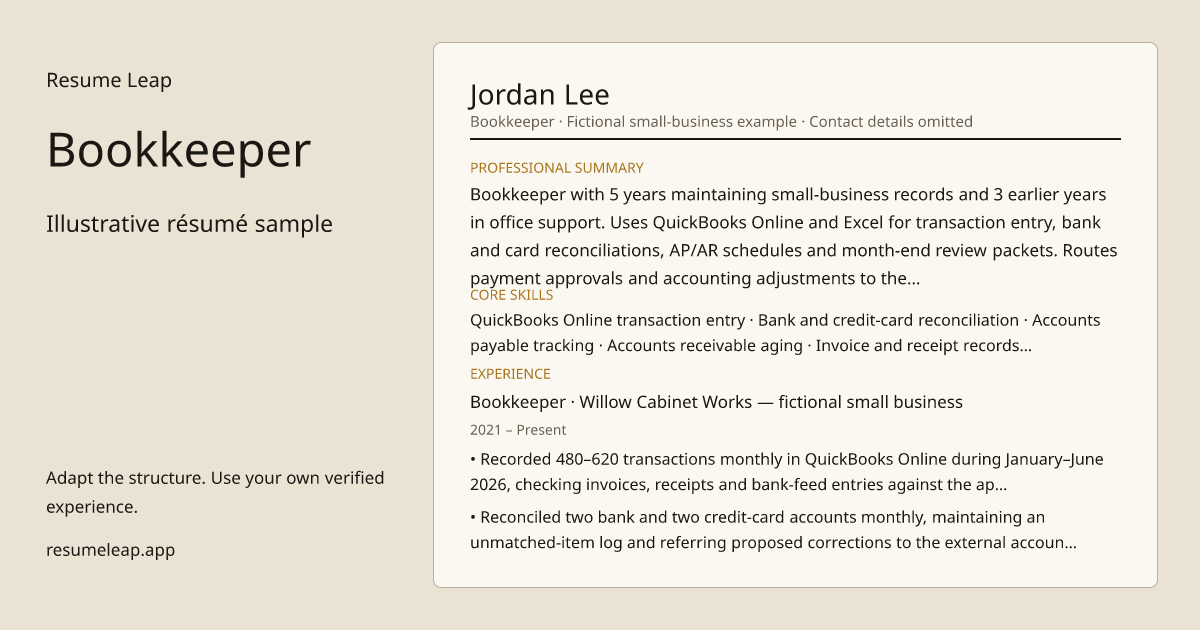
Professional Summary
Bookkeeper with 5 years maintaining small-business records and 3 earlier years in office support. Uses QuickBooks Online and Excel for transaction entry, bank and card reconciliations, AP/AR schedules and month-end review packets. Routes payment approvals and accounting adjustments to the owner or external accountant.
Core Skills
Experience
- Recorded 480–620 transactions monthly in QuickBooks Online during January–June 2026, checking invoices, receipts and bank-feed entries against the approved account list.
- Reconciled two bank and two credit-card accounts monthly, maintaining an unmatched-item log and referring proposed corrections to the external accountant.
- Prepared weekly receivables-aging and supplier-payment lists for owner review; recorded approved payments and follow-up notes without authorizing disbursements.
- Assembled month-end bank reconciliations, aging schedules and an exception log for the external accountant; exported draft profit-and-loss and balance-sheet reports after approved entries.
- Logged approximately 200 supplier invoices per quarter in the office register, matched them to available delivery records and routed mismatches to the office manager.
- Maintained an electronic receipt index by month and supplier so the bookkeeper could retrieve supporting documents during account reviews.
Education
Associate Degree in Accounting — fictional community college, completed 2018.
Entry-Level Bookkeeper Resume Example
Complete constructed example for an applicant with completed accounting coursework, a practice bookkeeping project and retail cash-handling experience. The practice records, organizations, dates and quantities are fictional; the project is not client work or bookkeeping employment.
This alternative is also a constructed example. Replace its organizations, experience and numbers with your own supported facts.
Professional Summary
Entry-level bookkeeping applicant with completed introductory accounting coursework and a practice-company project using QuickBooks Online and Excel. Brings retail experience checking register totals, documenting differences and handing records to a supervisor. Seeking supervised transaction-entry and reconciliation work.
Core Skills
Projects
Completed classroom exercise using entirely fictional invoices, receipts and statements; not a real business or client.
- Entered 80 fictional transactions over an eight-week accounting exercise in a QuickBooks Online practice file, organizing source documents by identifier.
- Reconciled two mock monthly bank statements to the practice ledger, documented differences and submitted the proposed corrections for instructor review.
- Built an Excel invoice register using filters, SUMIF and a pivot table to summarize amounts by supplier and check totals against the exercise ledger.
Experience
- Compared register reports with counted cash at the end of three scheduled closing shifts weekly during May–August 2026, recording differences for supervisor review.
- Organized refund receipts and closing paperwork by date and register, handing the packet to the supervisor rather than approving adjustments.
- Answered customer payment questions and referred disputed transactions or exceptions outside the store procedure to the shift supervisor.
Education
Introductory Accounting and Spreadsheet Applications coursework — fictional community college, completed April 2026. High school diploma — fictional secondary school, completed June 2024.
Why this example is written this way
- The summary calls the applicant entry-level and identifies practice-file work rather than counting classroom time as professional bookkeeping experience.
- The Projects section comes before employment because it supplies direct bookkeeping evidence; the retail role retains its official cashier title and part-time status.
- Eighty transactions is the authored exercise total over eight weeks, not a weekly productivity target, commercial workload or measured business improvement.
- Two mock statements demonstrate what the exercise covered. Instructor review is identified; no client-account or independent accounting authority is implied.
- Retail cash checks describe a repeatable responsibility and escalation procedure, not perfect accuracy, reconciliation expertise or payment-approval authority.
- Course completion appears in education. No professional certification, credential issuer or exam result is invented.
Compare the facts behind the two bookkeeping samples
Both samples are fictional teaching examples, not successful candidates or employer-approved templates. The experienced case separates five years of bookkeeping from earlier office support. The entry-level case separates a completed practice exercise from paid retail work. Replace every employer, date, qualification and number with your own supportable history.
| Fact | Authored evidence | Boundary |
|---|---|---|
| Timeline | Office assistant, 2018–2021; bookkeeper, 2021–Present. | Do not count all years as bookkeeping employment. |
| Business and tools | Fictional small cabinet-making business; QuickBooks Online and Excel. | No claim about company revenue, tax advice or specialist credentials. |
| Transaction scope | Six monthly activity lists for January–June 2026 show 480–620 posted transactions per month. | A monthly workload range, not a guaranteed accuracy rate. |
| Reconciliations | Two bank and two card accounts, with monthly reconciliation packets and an exception log. | The accountant reviews proposed corrections; unmatched items are not concealed. |
| AP/AR and reporting | Weekly aging/payment lists and month-end review packets; owner authorizes payments. | Draft reports support review; payroll, tax filing and final financial-statement approval are outside this case. |
| Fact | Authored evidence | Boundary |
|---|---|---|
| Timeline | Part-time retail cashier from June 2024; accounting coursework completed April 2026. | No paid bookkeeping job is claimed. |
| Practice exercise | Eighty fictional transactions across March–April 2026; two mock bank statements. | All records are invented classroom material, not client data. |
| Software | QuickBooks Online practice file and an Excel supplier register. | Practice use does not establish professional production-system experience. |
| Transferable work | Three scheduled closing shifts weekly during May–August 2026; register totals, cash count and supervisor handover. | Documenting a difference is not the same as authorizing its adjustment. |
| Qualifications | Completed coursework and high school diploma; no professional credential. | Neither course completion nor exam preparation should be relabeled certification. |
Map the bookkeeping requirement to evidence and honest wording
| Requirement | Available evidence | Truthful wording | Limitation |
|---|---|---|---|
| Transaction entry | Primary sample: January–June posting lists and indexed source documents. | Recorded 480–620 monthly transactions in QuickBooks Online. | Volume does not prove completeness, error rate or financial-statement authority. |
| Bank reconciliation | Primary sample: four account packets and an unmatched-item log. | Reconciled two bank and two credit-card accounts monthly; routed proposed corrections for review. | Do not claim every difference was resolved or that you approved adjusting entries. |
| AP/AR support | Primary sample: dated aging lists, payment proposals and owner approvals. | Prepared weekly receivables-aging and supplier-payment lists for owner review. | No payment authority or measured collections improvement is established. |
| Month-end reporting | Primary sample: review packet, accountant instructions and draft report exports. | Assembled month-end schedules and exported draft reports after approved entries. | Do not equate preparation with final reporting, tax or audit responsibility. |
| Entry-level bookkeeping knowledge | Alternative: fictional ledger, exercise instructions and instructor feedback. | Completed an 80-transaction practice-company bookkeeping exercise. | Classroom evidence is not paid bookkeeping employment. |
| Payroll or tax filing | Neither sample contains direct experience. | Leave unsupported skills out; describe relevant record preparation only if true. | An unmet requirement remains a gap. Ask whether supervised training is available rather than inventing experience. |
Six bookkeeping bullet annotations: what supports each claim?
| Sample bullet | Records and period | What the wording establishes | Contribution and limit |
|---|---|---|---|
| Recorded 480–620 transactions monthly. | Six monthly posting exports for January–June 2026, checked against the authored source-document list. | The smallest and largest monthly counts define the range; this is scope, not an average or improvement. | Jordan records transactions under the approved account list; no accuracy percentage is calculated. |
| Reconciled two bank and two credit-card accounts monthly. | Four named account packets for each reporting month and a dated exception log. | Two plus two equals four accounts; count accounts, not every reconciliation step as a separate account. | Jordan compares balances and logs differences; the accountant reviews proposed corrections. |
| Prepared weekly receivables-aging and supplier-payment lists. | Dated weekly lists, follow-up notes and owner approval records. | Recurring AP/AR support; neither a collection-speed reduction nor money saved is asserted. | The owner decides which payments to authorize. Do not credit the preparer with the whole cash-flow result. |
| Assembled month-end review packets and exported draft reports. | Monthly checklist, reconciliations, aging schedules, exception log and approved-entry record. | The deliverable and review sequence, without an unsupported faster-close figure. | Draft reports are prepared for accountant review; “audit-ready” or tax-compliant conclusions are not established. |
| Compared register reports with counted cash on three closing shifts weekly. | Alternative: assigned shift schedule and closing packets for May–August 2026. | The applicant’s scheduled responsibility, not the store’s total shifts or an error-free streak. | Avery records differences and hands them to the supervisor; no authority to approve adjustments is claimed. |
| Entered 80 fictional transactions over an eight-week exercise. | Alternative: March–April exercise instructions, 80 source identifiers and practice ledger. | A complete classroom workload with an explicit period and fictional records. | Avery completed a practice exercise reviewed by an instructor; there is no customer, revenue or hiring outcome. |
Keep bookkeeping scope, qualifications and source records clear
The BLS occupational overview describes recordkeeping, checking figures and computer-based work, with duties and entry routes varying across employers. Use it to understand representative work, then read the vacancy. A business may divide payroll, payments and accounting review among several people; your resume should describe your own part.
- ▸For credentials, distinguish the exact professional qualification you have earned from a completed course, software practice or exam preparation. These examples deliberately omit professional credentials.
- ▸Before using a number, note the source, period, unit, calculation and your part. Keep employer/client documents private; a resume can describe the method without exposing records.
- ▸Prefer a specific task and review boundary over “managed all finances,” “perfect accuracy” or “ensured compliance” when your evidence does not establish that scope.
Build a focused skills section, learn how to quantify achievements without inventing figures, then tailor the evidence to the actual vacancy. An employer’s requirement remains unmet when you have no corresponding experience; a matching word cannot resolve that gap.
Use the work-experience section examples for promotions and date ranges, then keep the bookkeeping review boundaries shown here. A course project belongs in Projects or Education rather than being renamed a paid role.
For a qualification still in progress or course practice without an awarded credential, use the education-section examples to keep the status accurate.
Job-description terms for a bookkeeper résumé
These role-related terms are prompts for reviewing a specific job description. Include only terms that accurately describe your experience. Employers use different systems and criteria; this list does not represent a universal scoring model.
Common bookkeeper résumé mistakes
- ✕Calling coursework or practice-company exercises paid bookkeeping employment. Keep projects, training and actual employment separately labeled.
- ✕Claiming a perfect accuracy streak or a saving without records, a defined period and a calculation. A transaction count describes workload; it does not prove error-free accounts.
- ✕Using “full-charge” to imply payroll, tax filing or final financial-statement authority that belonged to an owner, accountant or outside provider.
- ✕Listing accounting software without explaining the edition and tasks used, or adding a product named in the posting that you have never used.
- ✕Describing preparation as approval: distinguish drafting a payment list, reconciling an account and routing an exception from authorizing payments or approving an adjusting entry.
- ✕Presenting course completion or exam preparation as an earned professional credential. Use the issuer’s exact credential name only when you hold it.
Frequently asked questions
What software should a bookkeeper resume list?
How do I quantify bookkeeping on a resume?
What is the difference between a bookkeeper and a full-charge bookkeeper resume?
Do bookkeepers need certifications on a resume?
How do I describe bookkeeping experience on a resume?
How do I write a bookkeeper resume with no experience?
Can I list payroll or tax filing if I only prepared the records?
Build a résumé from your own experience
Create an account, add your own profile and a target job description, then use Resume Leap to draft and review your résumé. This signup link does not import the sample. Export a PDF and follow the employer’s requested format.
Keep exploring
Resume example
Accountant Resume Example
Resume example
Financial Analyst Resume Example
Resume example
Office Manager Resume Example
Resume example
Administrative Assistant Resume Example
Guide
How to Quantify Resume Achievements: Find and Check Your Numbers
Guide
Resume Skills Section Examples: What to Include and How to Organize It
Guide