
Accountant Resume Examples and Writing Guide
What makes a strong accountant résumé
An accountant resume should show the records, reconciliations and reporting tasks you performed, the systems you used and who reviewed or approved your work. Use supported scope or outcome figures when useful, and state credentials precisely. These two complete, constructed examples show an experienced staff accountant and a graduate applicant; their fictional employers, dates and figures are teaching material, not facts to copy into your history.
Accountant résumé sample
This is an illustrative résumé. Names, organizations and accomplishments are constructed examples; replace them with your own verified experience.
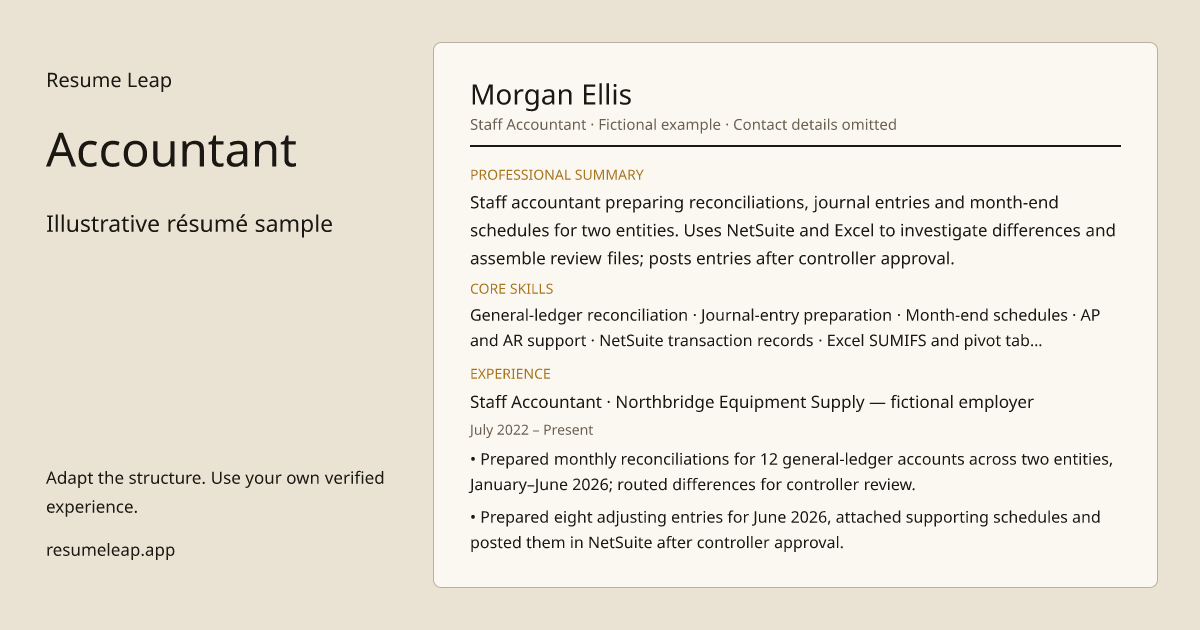
Professional Summary
Staff accountant preparing reconciliations, journal entries and month-end schedules for two entities. Uses NetSuite and Excel to investigate differences and assemble review files; posts entries after controller approval.
Core Skills
Experience
- Prepared monthly reconciliations for 12 general-ledger accounts across two entities, January–June 2026; routed differences for controller review.
- Prepared eight adjusting entries for June 2026, attached supporting schedules and posted them in NetSuite after controller approval.
- Checked 75–95 supplier-invoice packets weekly during May–June 2026, documenting missing support and routing exceptions before payment approval.
- Investigated a $240 duplicate bank-fee posting, proposed its reversal and updated the reconciliation after the controller approved the correction.
- Assembled month-end schedules and requested audit-support files; the controller approved final reporting and external auditors determined their opinion.
- Matched supplier invoices to purchase and receipt records, flagged differences and maintained the supporting-document index.
- Prepared receivables-aging extracts and recorded follow-up notes for the staff accountant; did not approve credit adjustments or customer write-offs.
- Maintained prepaid-expense schedules in Excel and supplied proposed monthly entries for accountant review.
Education
B.S. in Accounting — fictional North Valley College, completed May 2019.
Entry-Level Accountant Resume Example
Complete constructed graduate example with a labeled accounting-course project, a supervised internship and earlier retail work. All organizations and records are fictional. Coursework is not professional accounting employment, and no CPA license or examination result is claimed.
This alternative is also a constructed example. Replace its organizations, experience and numbers with your own supported facts.
Professional Summary
Accounting graduate with a completed practice-company project in Excel and a supervised accounting internship. Has prepared mock journal entries, reconciled practice statements and organized supplier records. Seeking a junior role with review and training; no professional license is claimed.
Core Skills
Education
B.S. in Accounting — fictional Lakeshore College, completed May 2026. Relevant completed coursework: financial accounting, managerial accounting and spreadsheet applications.
Projects
Completed accounting-course exercise using fictional source documents in Excel; not client work or paid employment.
- Prepared 40 mock journal entries from the supplied transaction list, linked supporting documents and produced a practice trial balance for instructor review.
- Reconciled two mock monthly bank statements, identified timing items and proposed corrections against the exercise answer key.
- Used SUMIFS and a pivot table to summarize the practice ledger by account and check the worksheet totals.
Experience
- Organized 12 supplier-statement review packets during the internship, listing unmatched invoices for the supervising accountant.
- Indexed invoice and receipt records by document identifier and date; referred proposed corrections to the supervisor without posting or approving entries.
- Compared closing register reports with counted cash and recorded differences for the shift supervisor.
- Filed refund receipts and referred disputed payments to a supervisor; did not authorize cash adjustments.
Why this example is written this way
- The project is explicitly coursework with fictional records. Its placement highlights relevant evidence without changing its status into an accounting job.
- The internship keeps its official title and limited responsibilities. Organizing a review packet does not imply ledger posting, reconciliation sign-off or financial-statement approval.
- Education is completed, not expected. No GPA, CPA status or software proficiency is invented to meet a presumed hiring threshold.
Check the facts behind both accountant samples
These are instructional cases, not successful candidates or an accounting procedure manual. Their source records are authored facts rather than real business data. Use the structure to describe your own scope and evidence; do not copy the amounts, employers or qualifications.
| Fact | Authored evidence | Boundary |
|---|---|---|
| Timeline and education | Accounting assistant, August 2019–June 2022; staff accountant, July 2022–Present; accounting degree completed May 2019. | Earlier assistant work is not relabeled as staff-accountant experience. |
| Reconciliation scope | Six January–June 2026 close files each cover the same 12 general-ledger accounts across two entities. | Twelve is the account count in each monthly scope; two is the entity count. Neither is an accuracy rate. |
| June entries | An eight-item approved-entry register contains six accrual entries, one reclassification and one duplicate-fee reversal. | Morgan prepared and posted the approved entries; the controller reviewed and authorized them. |
| Invoice checks | Eight weekly lists in May–June 2026 contain 75–95 supplier-invoice packets per list. | The unit is a packet checked, not an invoice paid. No processing-time or payment-timeliness improvement is measured. |
| Review and systems | NetSuite records, Excel schedules and controller sign-offs support the work; final reports and payment approvals belong to the controller. | No tax-signing authority, CPA license, independent audit responsibility or financial recovery is claimed. |
| Fact | Authored evidence | Boundary |
|---|---|---|
| Education | B.S. in Accounting completed May 2026 at a fictional college. | No professional license or examination progress is included. |
| Course project | January–April 2026 exercise includes 40 transactions requiring 40 mock journal entries and two monthly bank statements. | Practice-company records in Excel; not customer data, a commercial workload or an audit. |
| Internship | June–August 2025 placement; an index lists 12 supplier-statement review packets prepared for the supervising accountant. | Twelve packets over the whole internship, not twelve per week; no posting or approval rights. |
| Transferable work | Part-time retail associate, August 2023–May 2025; closing cash checks, receipt filing and escalation. | Cash handling is not equivalent to independent accounting responsibility. |
Match accounting requirements to evidence and precise wording
BLS describes accounting work including financial records, analysis and explanations to other people. Actual roles and review arrangements differ. Use the specific posting rather than treating the duties or tools below as requirements for every accountant. BLS occupational guidance
| Requirement | Available evidence | Truthful wording | Limitation |
|---|---|---|---|
| Account reconciliation | Primary: six close files, account list, exception notes and controller review. | Prepared monthly reconciliations for 12 general-ledger accounts across two entities. | Does not establish that all differences were resolved or that Morgan approved the close. |
| Journal entries | Primary: eight June entries, attached schedules and approval history. | Prepared eight adjusting entries and posted them after controller approval. | Preparing, approving and posting are separate actions; do not turn one into the others. |
| Accounts payable support | Primary: eight dated weekly packet lists and exception notes. | Checked 75–95 supplier-invoice packets weekly during May–June 2026. | No payment authorization, error-rate denominator or speed improvement is established. |
| Financial reporting or audit support | Primary: requested schedules, file index and reviewer instructions. | Assembled month-end schedules and requested audit-support files. | Support does not establish report sign-off, an audit opinion or compliance assurance. |
| Junior accounting knowledge | Alternative: course instructions, mock ledger and instructor feedback. | Completed a practice accounting cycle with 40 mock journal entries. | Course evidence is not paid accounting employment. |
| Software | Primary uses NetSuite and Excel; alternative uses Excel in coursework and document indexes in an internship. | Name the actual system and task, with practice use labeled. | A missing required platform remains a gap; do not insert an untried ERP name. |
Six accountant bullet annotations: records, period and contribution
| Sample bullet | Source records and measurement period | Scope and individual contribution | Interpretation limit |
|---|---|---|---|
| Primary: reconciliations for 12 accounts across two entities. | Account list and six monthly close files, January–June 2026. | Morgan prepares the same 12-account scope each month; the controller reviews it. | Not 72 unique accounts, a perfect-accuracy claim or independent close approval. |
| Primary: eight adjusting entries prepared and posted after approval. | June 2026 entry register: six accrual entries + one reclassification + one duplicate-fee reversal = eight. | Morgan prepares support and posts authorized entries; the controller approves them. | Entry count does not establish value created, an error rate or authority to approve. |
| Primary: 75–95 supplier-invoice packets checked weekly. | Eight weekly checklists in May–June 2026. | A workload range for packets personally checked and exceptions routed. | Not an exact monthly total, cash paid or proof that all invoices were correct. |
| Primary: investigated a $240 duplicate bank-fee posting. | Fictional June 2026 issue REC-2026-06-01 and approval history below. | Morgan traces the entry and proposes a correction; the controller approves it. | Removing a duplicate ledger expense does not recover money from the bank. |
| Alternative: 40 mock journal entries prepared. | Course transaction list and completed workbook, January–April 2026. | Taylor prepares 40 practice entries and supplies the workbook for instructor review. | No client, commercial transaction volume or professional accounting tenure is implied. |
| Alternative: 12 supplier-statement packets organized. | Internship file index, June–August 2025. | Taylor organizes supporting records and lists unmatched invoices for the supervisor. | No reconciliation sign-off, adjustment posting or payment authority is established. |
A fictional reconciliation issue log: correction is not cash recovery
Constructed documentation example REC-2026-06-01, not a real investigation or financial recommendation. This issue supplies the $240 figure in the experienced sample. The source statement shows one fee, while the authored ledger contains the same fee twice.
| Field | Authored record or action |
|---|---|
| Source records | June bank statement lists one $240 bank fee; the general ledger contains two $240 entries referring to that fee. |
| Discrepancy | Ledger fee total $480 − statement fee $240 = $240 duplicate expense recorded in this example. |
| Investigation | Morgan compares the statement reference, posting dates and document identifiers and logs the second entry as a proposed duplicate. |
| Candidate action | Morgan prepares supporting evidence and a proposed $240 reversal; no unilateral deletion or bank refund request is claimed. |
| Reviewer responsibility | The controller checks the evidence, authorizes the reversal and reviews the updated reconciliation. Morgan then posts the approved entry within assigned access. |
| Final status | The corrected ledger contains one $240 fee. The issue log records the review and approved correction; no cash was returned and no other account is claimed error-free. |
Describe CPA status without confusing study and licensure
NASBA advises candidates to identify examination sections completed and examinations scheduled. Keep those facts separate from licensure and check your current records before using them. Neither sample above claims a CPA license or an examination result. NASBA candidate-resume guidance
| Actual status | Accurate wording pattern | Supporting record | Avoid |
|---|---|---|---|
| Earned, currently held license | Certified Public Accountant (CPA) — [issuing Board of Accountancy], [jurisdiction]; state current status accurately. | Current issuer or licensing-board record. | Claiming an active license from an examination pass alone. |
| Named examination sections passed | CPA examination: [section names] passed [month/year]; no license held. | Current official section results; confirm that the wording still reflects the record. | CPA after your name or a claim that partial examination completion is licensure. |
| Examination appointment scheduled | CPA examination: [section] scheduled [month/year]. | Confirmed current appointment. | Passed, certified or licensed before that status is earned. |
| Preparation only | Studying for [named examination section], if relevant and helpful. | Your actual preparation activity; do not imply eligibility or an appointment. | An unspecified “CPA in progress” badge presented as a credential. |
Adapt the sample to the accounting job you want
- ▸Compare the posting with records you can support. Use skills-section guidance to connect each system or method to something you did.
- ▸Choose appropriate scope figures and check their basis with the quantification method. A useful qualitative explanation is preferable to an invented percentage.
- ▸Keep titles, promotions and dates accurate using the work-experience guide; label degrees, study and credentials with the education-section guide.
- ▸For a role centered on transaction records, AP/AR lists and routine bookkeeping support, compare the bookkeeper examples rather than relabeling all work as staff accounting.
Job-description terms for a accountant résumé
These role-related terms are prompts for reviewing a specific job description. Include only terms that accurately describe your experience. Employers use different systems and criteria; this list does not represent a universal scoring model.
Common accountant résumé mistakes
- ✕Treating preparing, reviewing, posting and approving as interchangeable. State the work you performed and the controller, supervisor or other reviewer responsible for approval.
- ✕Using “CPA in progress” without explaining whether you are studying, have scheduled an examination or have passed named sections. Examination progress is not an earned license.
- ✕Listing software you have not used because it appears in a posting. Explain what you did in each system and label practice use.
- ✕Claiming a clean audit, perfect accuracy or money recovered because you prepared schedules or corrected a posting. Those records do not establish an audit opinion, an error rate or a cash recovery.
- ✕Presenting coursework as paid accounting employment or listing a team-wide close improvement as your individual result.
Frequently asked questions
What should an accountant resume include?
How do I write an entry-level accountant resume?
How should I describe my CPA status?
What accounting software should I list?
How can I quantify accountant responsibilities without making up results?
How do I distinguish preparing, posting and approving entries?
Is an accountant resume different from a bookkeeper resume?
Build a résumé from your own experience
Create an account, add your own profile and a target job description, then use Resume Leap to draft and review your résumé. This signup link does not import the sample. Export a PDF and follow the employer’s requested format.
Keep exploring
Resume example
Bookkeeper Resume Example
Resume example
Financial Analyst Resume Example
Guide
How to Quantify Resume Achievements: Find and Check Your Numbers
Guide
Resume Work Experience Section Examples: Jobs, Promotions and Dates
Guide